
On February 1, 2026, I started writing poulsback on a Sony VAIO P. I loved that little machine and wanted to keep it useful under Linux. Its Intel GMA500 graphics made that a more complicated wish than I had expected.
The early work was manual: writing code, reading disassembly and trying to understand what the old drivers were doing. I used local, abliterated language models to help interpret the binaries. It was slow, difficult work, with a lot of uncertainty between an explanation that sounded plausible and one that actually held up.
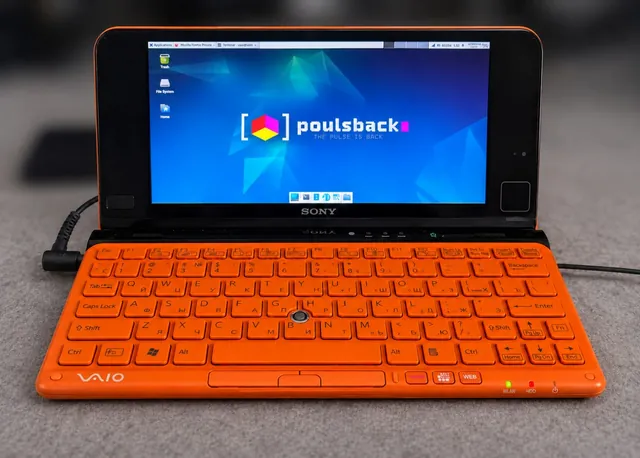
The machine that started it
Much of the first development happened on the VAIO. Early Linux sessions still relied on CPU rendering. The goal was to make the machine’s own graphics hardware useful, rather than leave its Atom doing all the work.
About six weeks into the project, the VAIO died. The repair shop diagnosed a motherboard failure. As far as I could tell, it was unrelated to the driver work, but the practical result was the same: I had a graphics-driver project and no machine on which to test it.
Another VAIO P would have been lovely. Good examples are expensive here in Japan, though, so the project needed another way forward.
Five hundred yen and another chance
Around July, I found a Dell Inspiron Mini 12 (1210) for ¥500 in the junk section of a local HARD OFF. It had the same GMA500 graphics. It would not turn on. Naturally, I bought it.
After finding a power adapter and repairing the power circuitry, I brought it back to life. Its battery and power connection remain temperamental, so I keep an eye on power conditions during tests. That rescued Dell became the project’s hardware reference.
Why keep going?
The VAIO had given the project its reason to exist. The Dell gave it a way to continue. Both machines had the same graphics core, so replacing the laptop did not mean abandoning the question that had started the work.
I wanted these small computers to have a useful place under Linux. That meant understanding the hardware well enough to build a maintainable graphics stack around it. The old drivers offered clues, while writing a new driver meant turning those clues into code that could be read, built and tested.
The project grew from that practical wish: keep an interesting machine useful, learn how its graphics work and leave something other people could understand and improve.
Questions, testing, documentation and unfinished ideas are welcome. The public repository is a place to start reading or join in. The next chapter follows the rescued Dell and its role in the work.